
Insurance & value
When is a boat a total loss? What 1,162 insurance write-offs show about repair costs, actual cash value and agreed value
How insurers decide to total a boat, agreed value vs actual cash value, and what repair estimates on 1,162 insurer-sold Copart boats show about write-offs.
By the boat.vin team · · 9 min read
In this guide
When an insurer decides a car is a total loss, a lot of the decision is written into state law. Many states set a damage threshold as a percentage of the car's value, and a car past that line is branded salvage. Boats have nothing like that. Whether a damaged boat is repaired or written off comes down to the wording of the policy, an adjuster's estimate, and what the wreck is worth to someone else. And the label that follows a written-off boat afterwards doesn't measure money at all.
So what does "totaled" actually mean for a boat? We looked at the boats that insurers wrote off and sent to auction. Copart's US listings show two numbers next to each other on many lots: an estimated retail value and a repair estimate. We found 1,162 boats and personal watercraft sold by named insurers where both were filled in. Here is what they show, and what they mean if your own boat has just been damaged or you're thinking of buying one an insurer gave up on.
First, what the policy promises: agreed value or actual cash value
Almost every boat policy settles a total loss in one of two ways, and which one you have matters more than anything else in this article.
An agreed value policy fixes the boat's value when the policy is written. Chubb, one of the large US boat insurers, puts it plainly in its guide to boat insurance: these policies "normally pay the amount shown on the policy if the boat is considered to be a total loss". You know the figure in advance, and it doesn't shrink as the boat ages within that policy term. That certainty is why the premium is higher.
An actual cash value (ACV) policy pays what the boat was worth just before the loss. In Chubb's words, it "provides coverage up to the current market value of the vessel in the event of a total loss". Market value is set after the loss, usually by the adjuster, from sales of similar boats, guides and condition. The same guide notes that partial-loss payments under ACV policies are usually reduced for physical depreciation too. Older boats are often insured on ACV terms, so the owner of a 20-year-old runabout may have one without realizing it.
Neither kind of policy says how much damage makes a total loss. That part is left to the adjuster, and that's where it gets interesting.
How an insurer decides to write a boat off
The idea behind a write-off is old marine insurance law. Britain's Marine Insurance Act 1906, still in force and the model for marine insurance law in many countries, defines a constructive total loss as damage where "the cost of repairing the damage would exceed the value of the ship when repaired". The boat still exists, but fixing it makes no economic sense.
A modern adjuster works with the same logic and a few more numbers. On one side are the repair estimate and the costs of the claim (recovery, storage, haul-out). On the other are the boat's value under the policy and what the insurer can get back by selling the wreck. If paying out the value and selling the wreck costs the insurer less than repairing the boat, the boat gets written off. Salvage value is the piece people forget. A two-year-old boat with a flooded engine still has a valuable hull, trailer and electronics, and an insurer that can recover a good share of its payout at auction will total it much earlier than an old boat whose wreck is worth almost nothing.
The exact formula is the insurer's own and isn't published. But its results end up on auction listings.
What 1,162 written-off boats show
Our sample is every boat and personal watercraft in boat.vin's archive of Copart US listings, as of November 12, 2026, where the seller was a named insurer (Progressive, Farmers, GEICO, State Farm or Bristol West) and the listing showed both an estimated retail value and a repair estimate greater than zero: 858 boats and 304 personal watercraft. The median boat in the sample had an estimated retail value of $13,500.
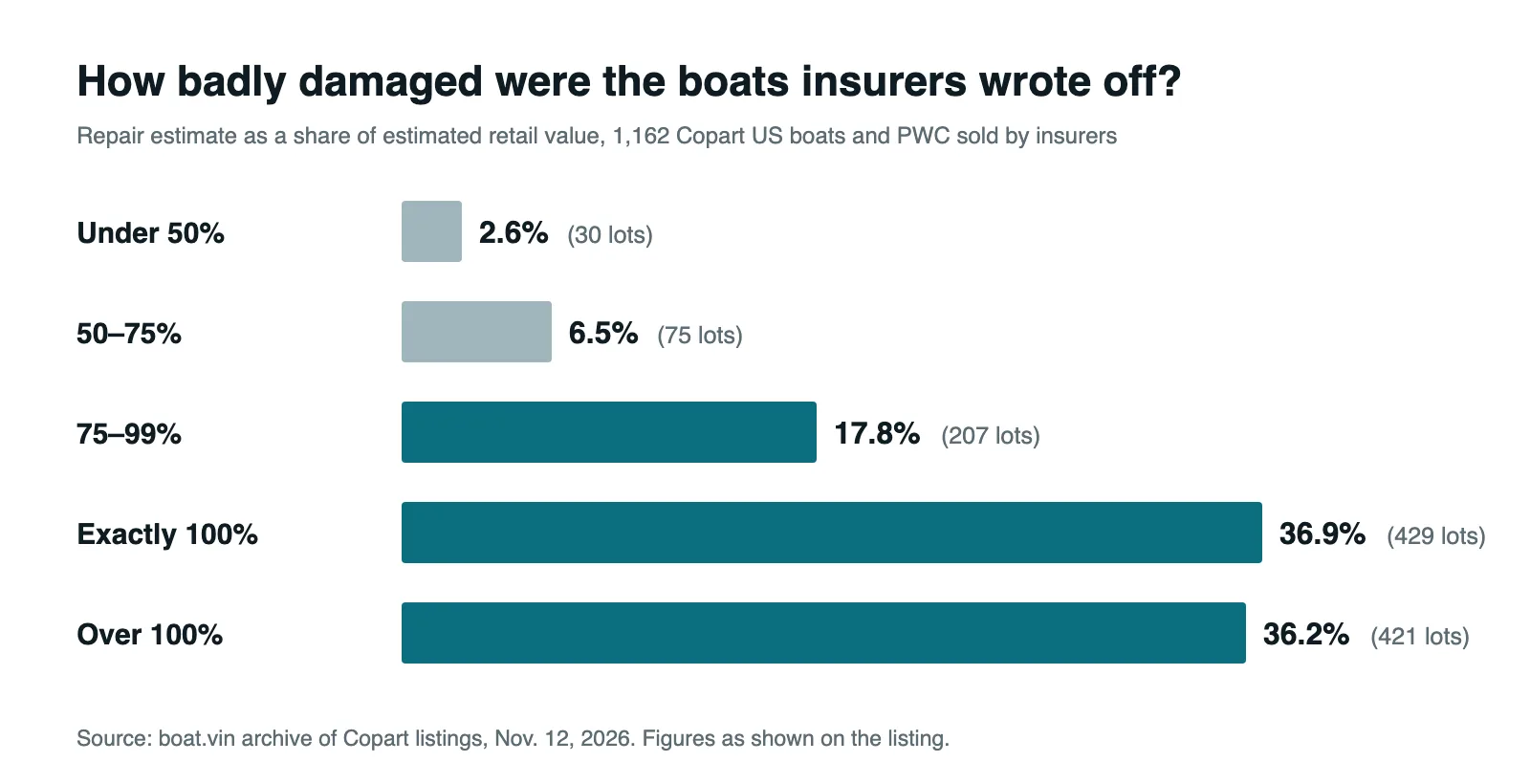
Three things stand out.
Cheap-to-fix write-offs are rare. Only 30 of the 1,162 lots (2.6%) had a repair estimate below half the boat's estimated retail value, and 105 (9%) were below 75%. If you're hoping for an insurance write-off that only needs a weekend's work, the listings say that's the exception.
Most were clearly beyond repair on paper. 421 lots (36%) had a repair estimate above the retail value. Another 207 (18%) were between 75% and 99%, which is where salvage value and claim costs usually tip the decision.
More than a third show the same number twice. On 429 lots (37%), the repair estimate is exactly equal to the retail value, to the dollar. Real repair estimates almost never land on a boat's value by chance. These look like a field filled in with the value rather than an appraisal of the work, so for these lots the repair figure tells you nothing beyond "the insurer totaled it". Treat it that way when you read a listing.
Newer boats get written off with less damage
Split by model year, the pattern the salvage logic predicts shows up clearly.
| Model year | Lots | Average est. retail value | Repair estimate under 75% of value | Repair estimate at or above value |
|---|---|---|---|---|
| 2020 and newer | 321 | $33,109 | 47 (14.6%) | 206 (64.2%) |
| 2010–2019 | 307 | $23,196 | 27 (8.8%) | 218 (71.0%) |
| 2000–2009 | 319 | $16,921 | 21 (6.6%) | 246 (77.1%) |
| Before 2000 | 215 | $10,281 | 10 (4.7%) | 180 (83.7%) |
Boats from 2020 or later were three times as likely as pre-2000 boats to be written off with a repair estimate under 75% of their value. That fits the arithmetic above: a newer boat's wreck is worth more at auction, so the insurer loses less by totaling it. For an old boat, the insurer usually only gives up once the repairs clearly cost more than the boat is worth.
Flood boats are the most clear-cut
Water and flood damage was the most common primary damage label in the sample (311 lots), and the most decisive: 75% of flood lots had a repair estimate at or above the retail value, and only 6.8% were under 75%. Undercarriage damage, often from grounding or trailering, was the least: 13.5% of the 171 lots were under 75%. One oddity: 52 lots were labeled "Minor dents/scratches", yet 44 of them had a repair estimate at or above their value. Copart's damage labels are quick yard descriptions. When a label and an estimate disagree, believe neither until you've seen the boat.
What happens to the boat's title afterwards
With a car, a total loss usually means a salvage title. With a boat, it depends on the state, and the rule that exists is about the hull, not the money.
Many states don't title boats at all, or only some of them. A smaller group has adopted the Uniform Certificate of Title for Vessels Act, which adds a title brand. Virginia's version, in § 29.1-733.10 of its code, requires an insurer to apply for a new title branded "Hull Damaged" before it transfers a hull-damaged boat titled in Virginia, and an owner to disclose the damage when selling. Failing to do so carries a $1,000 civil penalty. But "hull damaged" has its own definition. The hull's integrity has to be compromised "by a collision, allision, lightning strike, fire, explosion, running aground, or similar occurrence", or the boat has to have sunk in a way that creates a significant risk to the hull.
Nothing in that definition mentions the repair cost or the insurance payout. A boat totaled because of a flooded engine and ruined electronics may carry no brand at all. A boat with a cracked hull that was repaired for a modest sum should carry it. That's why the title alone won't tell you whether a boat was once an insurance write-off. Our guide on checking a used boat's history covers where else to look.
If your own boat has just been damaged
A few things are worth knowing before you talk to the adjuster.
- Read the valuation clause first. Find out whether you have agreed value or actual cash value, and whether the policy switches from one to the other at a certain age. Everything else follows from that.
- On an ACV policy, the value is open to argument. The insurer's figure comes from comparable boats. If you have receipts for a repower, new electronics or a recent survey, send them. They're the evidence that your boat was worth more than an average one of its year.
- Ask what happens to the wreck. If the insurer totals the boat, it normally takes ownership and sells it, often through Copart or IAA. Some policies let the owner keep the boat for a reduced payout. Ask what the reduction would be before you decide. It's the insurer's estimate of the salvage value, and it tells you how they did the math.
- Check what the boat sells for. If your boat is sent to auction, you can follow it on boat.vin by its HIN or lot number. Use the HIN decoder, or look it up in the boats for sale.
If you're thinking of buying a written-off boat
Every boat in our sample was given up by an insurer that had its own adjuster look at it. That doesn't make them bad buys. It does mean the cheap, simple repair is the exception, and the listing's own numbers can mislead. A few rules follow from the data.
- Read the repair estimate as a ceiling on optimism, not a quote. It's what a shop would charge to repair the boat with new parts and paid labor. Doing the work yourself with used parts can cost far less, but only if the damage is what it seems.
- Ignore an estimate that equals the value. On more than a third of insurer lots it does, and in that case it's not an estimate of anything.
- Be most careful with flood boats. They're the most common write-off, and the damage you can't see (wiring, fuel systems, foam, engine internals) is what drives the cost.
- Price in the fees. On a $2,500 bid, Copart's and IAA's buyer fees alone add more than $800. Our guide on buying a boat at Copart or IAA walks through the full cost. For jet skis, see our guide on salvage jet ski auctions.
Every lot page on boat.vin shows the estimated retail value and the repair estimate when the auction provides them, next to an all-in cost estimate. That's the quickest way to see where a particular boat sits on the chart above before you bid.
Sources and method
Auction figures come from boat.vin's archive of Copart US listings as it stood on November 12, 2026. The sample is every boat and personal watercraft lot whose named seller was an insurer (Progressive, Farmers Insurance, GEICO, State Farm Insurance or Bristol West Insurance) and whose listing showed an estimated retail value and a repair estimate above zero (1,162 lots). Both figures are as published on the listing. They are the auction's and seller's estimates, not the amount the insurer paid the owner, and they aren't independent appraisals. Damage labels are Copart's yard descriptions.
- Chubb, Understanding boat insurance, consulted November 12, 2026.
- Marine Insurance Act 1906 (UK), section 60, Constructive total loss defined, legislation.gov.uk.
- Code of Virginia, Title 29.1, Chapter 7, Article 2.1 (certificates of title for watercraft), including the definition of "hull damaged" and § 29.1-733.10, Title brand.
- boat.vin archive of Copart boat and personal watercraft listings, November 12, 2026.