
Buying guide
Buying a jet ski at Copart or IAA: what 1,493 salvage listings tell you, and what they leave out
Hours, keys, damage labels, titles and fees on salvage jet skis, from 1,493 Copart and IAA listings: what the listing confirms and what to check before you bid.
By the boat.vin team · · Updated · 11 min read
In this guide
Open a jet ski listing on Copart and look for the hours. On a used personal watercraft, engine hours are the closest thing to mileage, and they are what every private seller is asked first. On roughly half of the jet skis Copart had listed in the United States this autumn, the hours field carries the code "Not Actual". On another fifth it says "Exempt". Only 13% of listings give a reading the auction marks as actual.
That one gap sums up buying a jet ski at a salvage auction. Copart and IAA (Insurance Auto Auctions) sell hundreds of them every month: wave runners an insurer wrote off after a collision, machines that sank at the dock, theft recoveries, rentals, skis that simply got old. Many are nearly new. Some are excellent buys. But the listing tells you less than it seems to, and the auction won't fill in the gaps for you.
To see what the listings actually contain, we went through every personal watercraft in boat.vin's archive of Copart and IAA lots on November 10, 2026: 1,493 machines, 1,093 of them on Copart in the US, 315 on IAA in the US and the rest in Canada, most scheduled to sell between August and November 2026. Here is what that data shows, and what to do about the parts it leaves out.
What actually comes up for sale
Mostly young machines from two brands. BRP's Sea-Doo accounts for 54% of the personal watercraft in our sample (799 lots) and Yamaha for 36% (532). Kawasaki is a distant third at 5%, and the rest are mislabeled entries, older brands or makes the auction didn't record. The sellers are not who many first-time buyers imagine. Copart names the seller on about a third of its US jet ski lots, and on every one of those 387 lots the seller is one of four insurers: Farmers (111 lots), Progressive (99), State Farm (95) and GEICO (82).
The machines are newer than you'd expect from the word "salvage". Two thirds of the lots (65%) are 2018 models or later, and 37% are 2022 or newer. That is what an insurance total looks like on a personal watercraft: a two-year-old ski with a damaged hull or a flooded engine can cost more to repair than an insurer is willing to pay, even if it would be worth fixing for someone who can do the work themselves.
What the listing confirms, and what it doesn't
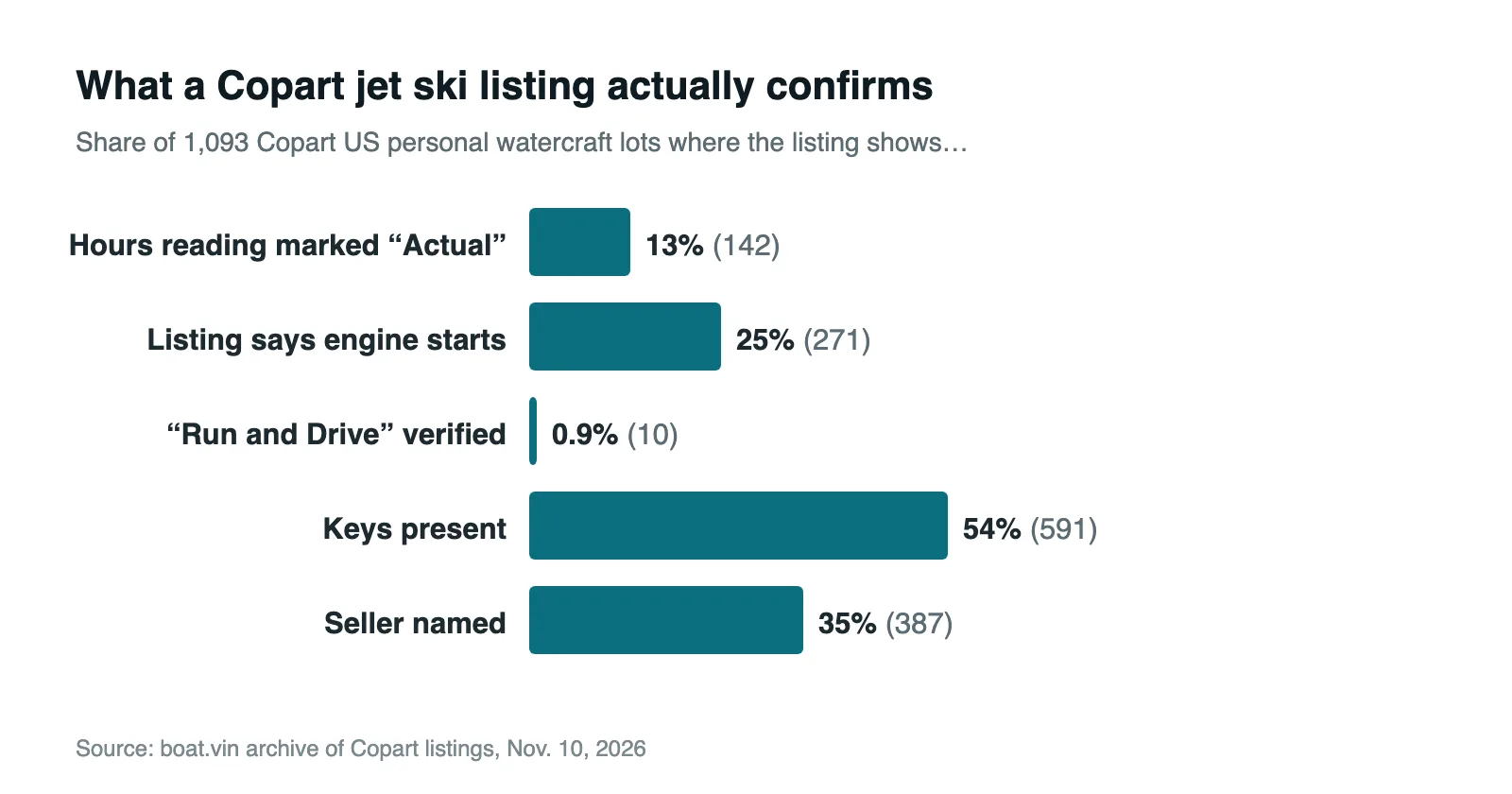
An auction listing for a jet ski is built from the same template as one for a car, and many of its fields don't fit a watercraft. Here is how often the Copart US listings in our sample confirmed the things a buyer most wants to know.
The hours meter
Copart reuses the odometer codes from car titles. In the wording state motor vehicle departments use, "Actual" means the reading is the true distance traveled, "Not Actual" means it isn't, "Exempt" means no disclosure is required, and "Exceeds mechanical limits" means the meter has rolled past what it can display (Wisconsin DOT). On a jet ski the field usually holds engine hours, if it holds anything. Among the 1,093 Copart US lots, 541 (49.5%) were coded Not Actual, 228 (21%) Exempt and 142 (13%) Actual. Another 176 had no code at all, and 723 lots showed a reading of zero.
A zero next to "Not Actual" means nobody read the meter, not that the machine is unused. Treat any hours figure on an auction listing as unverified, including the ones marked Actual, which reflect what the yard saw on the gauge.
The good news is that a modern four-stroke ski keeps its own record. The engine's control unit logs total running hours and stored fault codes, which a dealer can read with the manufacturer's software (BRP's BUDS for Sea-Doo, Yamaha's YDS for Yamaha). You can't do that before the sale, but you can do it before you put money into repairs, and a printout of the engine history is worth far more than the number on the listing when you come to resell.
"Starts" is not "runs"
About a quarter of Copart's US jet ski listings (271 lots) say the engine starts. Only ten (0.9%) carried Copart's "Run and Drive" verification. That is no surprise: you can't test-drive a watercraft across a gravel yard. But "starts" only means the engine turned over and fired when someone checked it, usually for a few seconds and out of the water, with nothing pumped through the cooling system. It says nothing about compression, overheating or what happens at full throttle.
On IAA's US jet ski lots, the "starts" field was almost never filled in. A blank there means unknown, not "doesn't start".
Keys
Copart reported keys present on 54% of its US jet ski lots and absent on 28%; the rest said nothing. On a car a missing key is a nuisance. On a personal watercraft it can be a dealer visit. Sea-Doo's D.E.S.S. keys are coded to the individual machine, so a replacement has to be programmed into it with dealer software, and other brands with security keys or remotes work in a similar way. Price that in when the listing says no keys.
How to read the damage labels on a jet ski
Copart's damage label is a quick assessment by yard staff, chosen from a list written for cars. It is useful as a starting point and dangerous as a conclusion. Here is how the 1,093 Copart US personal watercraft lots were labeled.
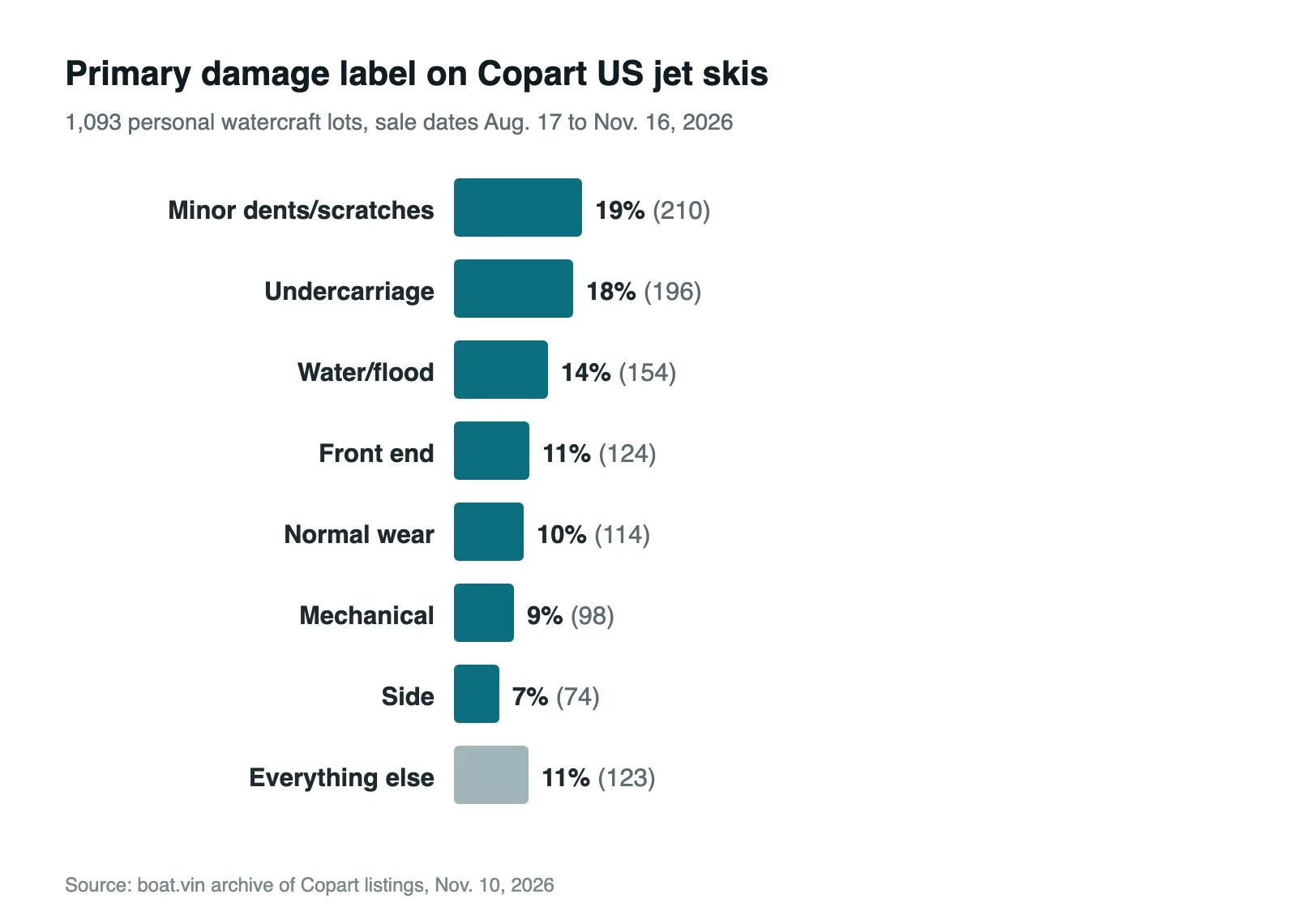
Minor dents/scratches (19%) and normal wear (10%) are the labels that tempt people most. Sometimes they are accurate, and the insurer totaled the ski for reasons that don't show in photos, or settled a theft claim and then got the machine back. But on a car "minor dents" describes the body. On a jet ski the expensive parts sit inside the hull, and a cosmetic label tells you nothing about them.
Undercarriage (18%) is the second most common label, and on a personal watercraft it points at the bottom of the hull and the jet pump. Skis that were beached, run aground or driven through shallow water pick up gouges in the hull and suck sand and stones into the intake, which chews up the impeller and its wear ring. Pump work is a known, finite repair. Hull damage near the pump or the ride plate is harder to judge from photos.
Water/flood (14%) sounds absurd for a watercraft, but it means water got where it shouldn't: a ski that sank at the dock or on a lift, swamped on its trailer, or sat through a hurricane surge. An engine that took in water can hydrolock, and cranking it before the water is cleared can bend a connecting rod. Salt water adds corrosion in the electrical connectors and the control unit. IAA sometimes says which kind: in our sample its labels included "Fresh Water" (11 lots) and "Salt Water" (4). On a flood lot, assume the engine and electrics need professional attention until proven otherwise.
Front end, side and rear labels usually mean a collision, with a dock, another boat or a trailer. IAA records the insurer's loss type as well, and on its 315 US jet ski lots collision was the most common by far (140 lots, 44%), followed by water (66, 21%), "other" (42), fire (10) and theft (5). Mechanical (9% on Copart) means something didn't work, and you won't know what until a technician looks.
Titles and paperwork
In short, an auction jet ski normally comes with one of three things: a salvage title, a clear title, or only a bill of sale, depending on the auction and the state the ski was titled in. Here is how often each appeared.
On Copart US, 67% of the jet skis in our sample (727 lots) were listed with a salvage title and 33% (361) with the title type "None". That word trips people up. On Copart it means no title information was given on the listing, not that the ski has no title. You need to find out which before you bid, because it decides whether you can register the machine in your state.
IAA's US lots looked different: 44% "Clear" (137), 28% "Bill of Sale" (87), 9% "Salvage" (28), and a handful "Repairable" (11) or "Non-Repairable" (7). A clear title on a salvage-auction ski is common and not a contradiction. Watercraft titling is a state matter: rules for branding a damaged watercraft vary widely, and some states don't title boats at all and only register them. A bill of sale is often all a buyer gets in those states. We explain how that patchwork works, and how to check a hull's history despite it, in our guide to checking a used boat's history with its HIN.
Before you bid, check that the state you'll register in will accept the document that comes with the lot. A non-repairable or parts-only document means exactly that: the machine can be stripped for parts but not put back on the water legally.
Check the hull number against the paperwork
Jet skis are stolen more than any other kind of watercraft. In its most recent detailed report, covering 2021, the National Insurance Crime Bureau counted 4,644 watercraft thefts in the US, and personal watercraft were the most stolen type, with 1,292. Only 42% of stolen watercraft were recovered that year (NICB via PR Newswire). When a stolen machine turns up after the claim has been paid, it usually belongs to the insurer, which can sell it like any other total. IAA listed theft as the loss type on five of its 315 US jet ski lots in our sample.
A recovered ski can be a fine purchase with clean paperwork. The risk is a machine whose hull identification number (HIN) has been altered or doesn't match its documents. Federal rules require the main HIN on the starboard (right) side at the back of the hull, plus a duplicate in a hidden spot, and any change to it must be obvious (33 CFR 181.29). Compare the number in the auction photos with the one on the title or bill of sale, and ask for a close-up if the photos don't show it. Note that IAA masks the HIN on its listings after the sixth character, so on IAA you will often have to confirm it at the yard. On Sea-Doo the first three characters are usually YDV, on Yamaha YAM and on Kawasaki KAW; our builder code table lists the others.
The boat.vin HIN decoder tells you who built the hull and the model year the number claims, which is a quick way to catch a 2023 ski wearing a 2015 number. It is not a history report, and a clean decode doesn't prove a clean past.
What the fees add to a jet ski
Jet skis sell at the price points where auction fees hurt most. Here is what the standard licensed-buyer schedules add at three typical bids, as boat.vin's fee calculator applies them in November 2026 (Copart's licensed member fees with a pre-bid, IAA's licensed buyer fees with a proxy bid), before sales tax, storage and transport.
| Winning bid | Copart US fees | Copart all-in | IAA US fees | IAA all-in |
|---|---|---|---|---|
| $1,500 | $648 (43%) | $2,148 | $670 (45%) | $2,170 |
| $4,000 | $983 (25%) | $4,983 | $975 (24%) | $4,975 |
| $8,000 | $1,163 (15%) | $9,163 | $1,205 (15%) | $9,205 |
At $1,500, the fees come to more than 40% of the bid at either auction. A cheap ski with an unknown engine is therefore rarely as cheap as it looks: add the fees, tax, a trailer ride home, and the cost of opening the engine, and a $1,500 bid can become a $4,000 project before you know whether it runs. Our guide to buying a boat at Copart or IAA explains each fee line, who can bid without a license, and why so many lots on reserve come back for a second sale.
Before you bid: a short checklist
None of this needs special tools. It needs a skeptical eye and an hour with the photos.
- Look at the bottom of the hull. Ask whether the photos show the intake grate, the pump and the ride plate. If they don't, assume the worst for an undercarriage lot.
- Look inside. Photos with the seat off show the engine bay. A water line, mud, silt or white corrosion on the engine means it sat in water.
- Read the hours as unknown. Base your offer on the model year and condition, and plan a dealer readout of the engine history after the sale.
- Price in the key. No keys on a model with coded keys means a dealer visit before it will run.
- Match the HIN in the photos to the paperwork, and run it through a HIN decoder.
- Check the document. Find out what "None", "Bill of Sale" or "Clear" means for registration in your state before you bid, not after.
- Set your maximum from the total. Work back from what you are willing to spend in all, fees and transport included, and remember the ski probably arrives without a trailer.
- Look at the brand and model. Compare similar lots for your make on the Sea-Doo, Yamaha and Kawasaki pages, or browse every jet ski at auction on boat.vin.
A salvage jet ski rewards buyers who can do their own mechanical work and who treat the listing as a set of leads rather than facts. Bought that way, a two-year-old Sea-Doo or Yamaha with a cracked hull or a drowned engine can cost a fraction of a dealer's price. Bought on the strength of a "minor dents" label and a zero on the hours meter, it can cost far more than it was ever worth.
About the data
The figures come from boat.vin's archive of personal watercraft listings at Copart and IAA in the US and Canada, as recorded on November 10, 2026: 1,493 lots, of which 1,093 were on Copart US and 315 on IAA US. Copart US lots had sale dates from August 17 to November 16, 2026. Brand names were grouped from the auctions' many spellings (Sea-Doo, SEADOO, Bombardier and so on). Damage labels, title types, odometer codes, keys and "starts" flags are the auctions' own fields, reported as listed. They describe the listing at the time we recorded it, not the machine's real condition, and auctions sometimes correct them later. Fees come from the schedules in boat.vin's fee calculator and exclude sales tax, storage and transport.
Sources
- boat.vin archive of Copart and IAA personal watercraft listings, US and Canada, November 10, 2026 (1,493 lots).
- Wisconsin Department of Transportation, eMV public FAQs: vehicle information (odometer statuses).
- National Insurance Crime Bureau, watercraft theft report for 2021, August 29, 2022.
- Code of Federal Regulations, 33 CFR 181.29, hull identification number display.
- Copart US licensed member fee schedule and IAA US licensed buyer fees, as applied by boat.vin's fee calculator, November 2026.