
Buying guide
There is no Carfax for boats. Here is how to check a used boat's history anyway
No national database tracks boats the way NMVTIS tracks cars. Where a boat's past is recorded, how to search each source by HIN, and what auction data shows.
By the boat.vin team · · 10 min read
In this guide
- Why the car system stops at the water's edge
- Start with the hull itself
- The paper trail: titles, registration and documentation
- The accident record mostly isn't there
- What salvage auctions reveal, and what our data shows
- Theft, recalls and liens
- A history check, in the order that catches the most
- About our numbers
- Sources
Type a car's VIN into any of a dozen websites and you get back a story: the states it was titled in, the odometer readings, the insurance write-off, the flood brand. Type a boat's hull identification number into the same sites and most of them will tell you, politely, that they don't know what you mean.
That is not because nobody tracks boats. It is because the records are scattered across fifty state agencies, a federal documentation office, insurers, police databases and two salvage auction companies, and no law ever told them to pool what they know. A buyer who wants a used boat's history has to visit each source in turn. This guide explains where each one is, what it can and cannot tell you, and what we found when we looked at a year of salvage boat sales ourselves.
Why the car system stops at the water's edge
The backbone of every car history report in the United States is the National Motor Vehicle Title Information System (NMVTIS), run for the Department of Justice. States, insurers, junk yards and salvage auctions are required to report to it, which is why a car that was totaled in one state can't easily be washed clean in another. Its own FAQ lists what it covers: automobiles, buses, trucks, motorcycles, recreational vehicles, motor homes and tractors. Boats are not on the list.
Without that federal spine, boat records follow state rules, and the rules vary more than most buyers expect. Most states issue titles for at least some boats, often depending on length or engine size. Some only register them. Delaware, for one, does not issue vessel titles at all, according to the National Association of State Boating Law Administrators. A registration certificate proves that someone paid a fee for a hull number; it is not proof of ownership, and it carries no brand for damage.
Even the identifier is different. A car's VIN is 17 characters and encodes the model, engine and plant. A boat's hull identification number, or HIN, is 12 characters and says much less: who built the hull, the builder's serial number, and when it was made. It says nothing about the engine, which on most boats carries its own serial number and may have been swapped several times.
Start with the hull itself
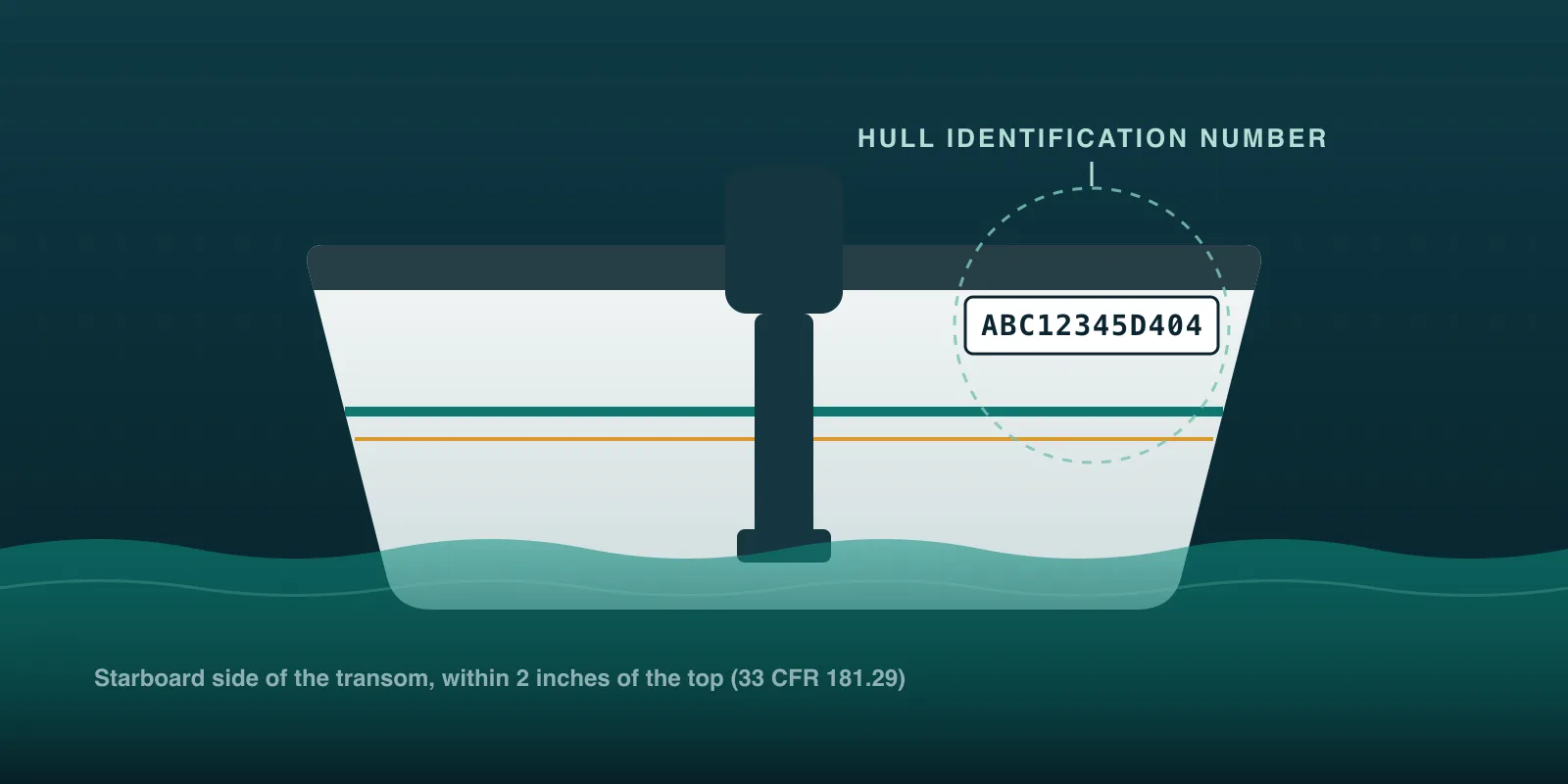
Every history check hangs on the HIN, so the first job is to make sure the number you are researching is really the boat's. Federal rules in 33 CFR 181.29 say where it must be. On a boat with a transom, the primary HIN goes on the starboard (right, seen from behind) outboard side of the transom, within two inches of the top of the transom, gunwale or hull-to-deck joint, whichever is lowest. A second, duplicate HIN has to be in an unexposed spot inside the boat or under a fitting. Both must be fixed so that altering, removing or replacing them would be obvious.
So look at both. A transom number that is freshly painted around, a plate held on by new screws, ground-down gelcoat or characters that don't line up are all reasons to stop. If the seller doesn't know where the duplicate is, the builder or a marine surveyor usually does. Then compare the HIN with the one on the title or registration, character for character. A swapped 0 and O, or 8 and B, is common on paperwork and worth fixing before money changes hands.
Next, read the number. A HIN in the current format, used since August 1, 1984, breaks down like this:
| Characters | Example: ABC12345D404 | What they mean |
|---|---|---|
| 1–3 | ABC | Manufacturer identification code (MIC), assigned by the US Coast Guard |
| 4–8 | 12345 | The builder's serial number for the hull |
| 9 | D | Month of production, A for January through L for December (D is April) |
| 10 | 4 | Last digit of the year of production |
| 11–12 | 04 | Model year |
Boats built between 1972 and mid-1984 use one of two older layouts, and our HIN decoder reads all three. The decode is a consistency test. If the listing says "2019 model" and the HIN ends in 15, or the builder code belongs to a different company than the brand on the console, something has been misdescribed. The Coast Guard keeps a public MIC search for checking who a code belongs to.
The paper trail: titles, registration and documentation
Ask for the title if the boat's state issues one, and the registration if it doesn't. Then contact the titling agency, often the DMV, sometimes the fish and wildlife department, and ask what it can tell you about that HIN. Policies differ: some states will confirm the current owner and any recorded lien to a prospective buyer, others only to the owner. Ask the seller to request it if you can't.
Title brands for boats exist, but unevenly. The Uniform Certificate of Title for Vessels Act, a model law from the Uniform Law Commission, requires a "hull damaged" notation on the title when the applicant knows of serious hull damage. A 2019 Florida Senate analysis counted four adopters at that time: Virginia, Connecticut, the District of Columbia and Hawaii. In most of the country, a boat that sank at the dock can come back on an ordinary title.
Larger boats may skip the state system entirely. A vessel of at least five net tons can be documented with the Coast Guard's National Vessel Documentation Center under 46 CFR Part 67, and many owners of cruisers and big sportfishers do it to simplify financing. For those boats, the federal record is the one that matters. The free PSIX search shows whether a vessel is documented and its basic particulars. For history, order an abstract of title, which lists the recorded owners and mortgages: the NVDC fee schedule puts it at $25, and a certificate of ownership at $125. A documented boat with an unreleased preferred mortgage is a boat the bank can still claim.
The accident record mostly isn't there
If you are counting on an accident report to reveal a boat's past, the Coast Guard's own numbers should temper that hope. Its 2024 Recreational Boating Statistics, the latest edition, recorded 3,887 incidents for a fleet of 11,674,073 registered recreational vessels. Federal rules require a report when damage to vessels and other property reaches $2,000, among other triggers.
The same report is frank about what that misses. It calls non-fatal incidents "severely under-reported" and cites a May 2023 analysis of insurance data from two states: for every property-damage incident in the Coast Guard's database, 12 to 21 actually occurred, and for every dollar of damage on file, between $7.27 and $21.77 of damage happened. Put plainly, the typical fender-bender, grounding or sinking at a mooring never becomes a public record. And even reported incidents are not something you can look up by HIN.
That makes two other sources more valuable than they look: the insurer, and the salvage auction.
What salvage auctions reveal, and what our data shows
When an insurer pays out on a boat it considers not worth repairing, the boat usually goes to a salvage auction, and in North America that mostly means Copart and IAA. Their listings are public while the sale is open and carry the HIN, photos, a damage description and a title label. Then the listing disappears from their sites. boat.vin keeps it: our archive holds the boats and personal watercraft sold through Copart and IAA in the United States and Canada, searchable by HIN on the HIN page and in the sold boats list. We looked at what that record shows. Three findings stand out.
Half the flooded boats came with a "Clear" title
IAA tags each lot with a loss type. Of the 1,167 boats and PWC that IAA listed for sale in the US between August 25 and November 12, 2026, 237 had the loss type "Water". Here is the title label on those 237:
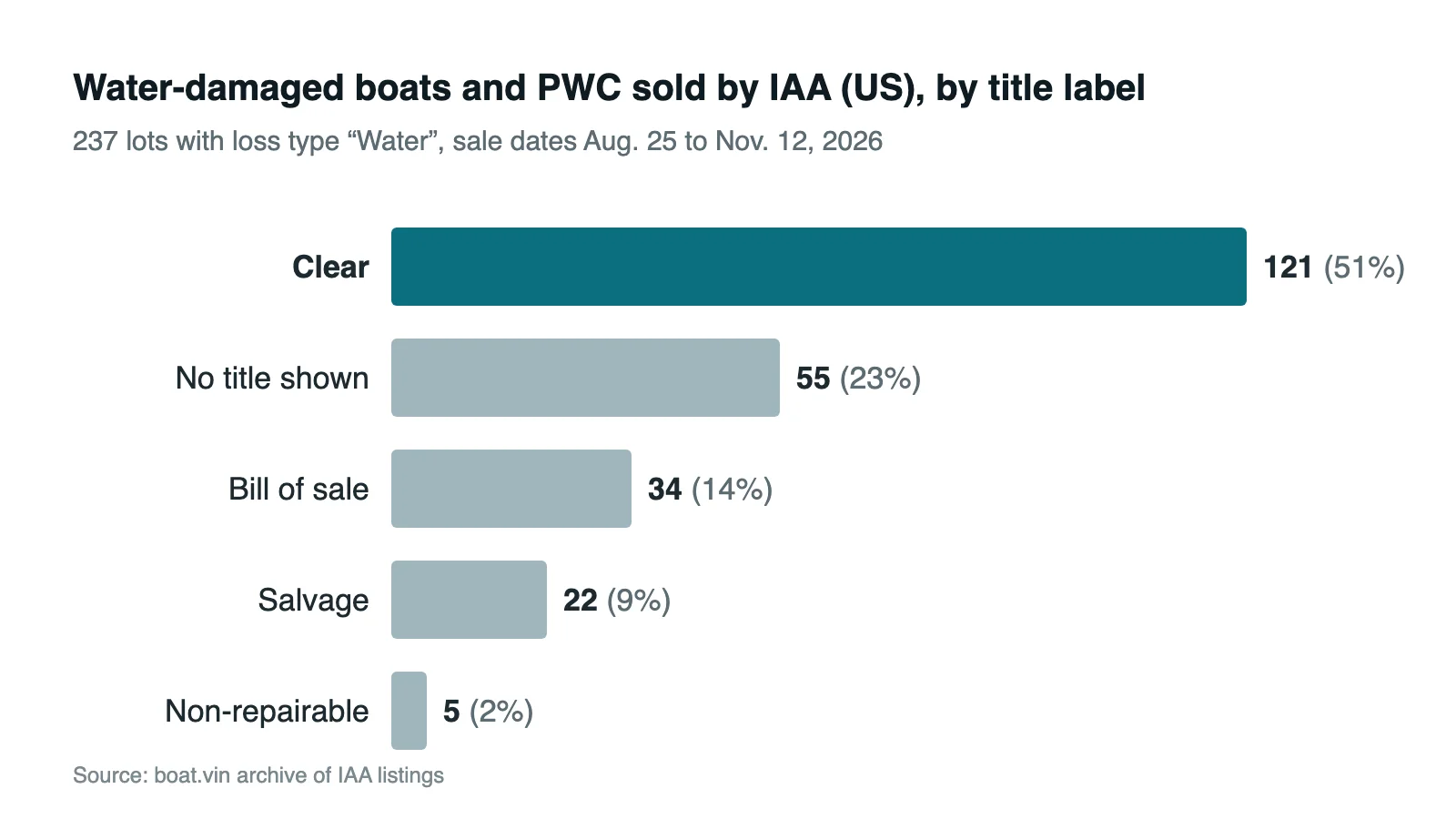
121 of them, 51%, were offered with a title IAA labels "Clear". That is not a scandal; it is how the system works. Whether an insurance total turns into a salvage brand depends on the state and on the boat, and many states have no salvage brand for boats at all. But it means a boat with a clean-looking title in your hands may have been sold as an insurance loss after it filled with water, and nothing on that title will say so. An archived auction listing will.
The same hull, a different description
Some hulls come back to auction. In the Copart listings we hold for the US and Canada, 92 HINs appear on two or more separate lots. In 38 of those, the primary damage label changed between listings. In 11, the first listing named water or flood damage and a later one did not mention it.
We don't read that as fraud. Copart's damage field is a quick yard assessment, a boat may be partly repaired between sales, and a lot can return because a buyer didn't pay. The lesson is narrower and more useful: a single listing is a snapshot. If you find one auction record for a hull, look for others, and read the earliest one closely.
Read the labels literally, and no further
Two quirks catch people out. On Copart, a title field of "None" means the listing gave no title information, not that the boat has no title. And in the IAA listings we archive, the HIN arrives partly masked, with only the first six characters shown, so an IAA match is a strong lead rather than proof. In both cases the next step is the same: ask the seller directly, and ask the titling state.
Theft, recalls and liens
Boats get stolen at a scale that surprises people. The National Insurance Crime Bureau counted 4,644 watercraft thefts in 2021, its most recent published tally, with a 42% recovery rate. Personal watercraft were the most stolen type, 1,292 of them, and the least often recovered, at 37%. Florida and California led by state. The NICB's free VINCheck tool is built on insurers' vehicle records, and by its own description it covers only some watercraft. A local police or sheriff's marine unit can run a HIN against theft records, and many will do it for a buyer standing in front of the boat with the seller.
Recalls are easier. The Coast Guard's recall database, with about 1,700 campaigns, can be searched by MIC or company, model and model year, which is exactly what the HIN gives you. Engine campaigns are in it too, under the engine maker's name; ask that maker about the engine's own serial number as well.
Liens are the expensive surprise. On a state-titled boat, a recorded lien appears on the title or in the state record. On a documented vessel, it appears on the NVDC abstract. Marine lenders and boat dealers can sometimes also check filings under the Uniform Commercial Code with the secretary of state. If a lien shows up, the release has to be in writing before you pay.
A history check, in the order that catches the most
- Photograph the transom HIN and find the duplicate. Check both for tampering and compare them with the paperwork.
- Decode the number with our HIN decoder and check that builder and model year match the listing.
- Search the auction record. Enter the HIN on boat.vin to see whether the hull passed through Copart or IAA, and read every listing you find, oldest first.
- Ask the titling state what it can tell you about owner, liens and brands. For a documented boat, order the NVDC abstract of title.
- Check recalls by MIC and model year, and for the engine by its own serial number.
- Ask for a theft check through local law enforcement before you pay.
- Hire a marine surveyor for anything worth a serious sum. Moisture meters and a hammer on the hull find the history that never made it into any record.
None of these sources is complete on its own, and some boats will have almost no paper trail at all. That is the honest answer to "is there a Carfax for boats": there isn't one database, but between the hull, the state, the Coast Guard and the auction record, most of a boat's past can still be found by someone willing to look in five places instead of one.
If you follow a particular hull, a boat.vin account can also watch a HIN and tell you when it shows up at auction; HIN watches are part of the paid plans. Developers can query the same archive through the boat.vin API.
About our numbers
The auction figures come from boat.vin's archive of Copart and IAA boat and personal watercraft listings in the US and Canada, as of November 5, 2026. The IAA figures cover the 1,167 boat and PWC lots with US sale dates between August 25 and November 12, 2026 (dates after November 5 are scheduled sales). Title labels and loss types are as the auction published them; we did not reinterpret them. The relisting figures count Copart lots whose 12-character HIN appears on more than one lot. Trailers sold on their own are excluded.
Sources
- Bureau of Justice Assistance, NMVTIS frequently asked questions.
- 33 CFR 181.29, Hull identification number display requirements.
- US Coast Guard, Recreational Boating Statistics 2024 (published July 2025).
- US Coast Guard, Manufacturer identification code search and recall database.
- 46 CFR 67.5, vessels eligible for documentation, and 46 CFR 67.550, documentation fees.
- US Coast Guard, Port State Information Exchange (PSIX) vessel search.
- NASBLA, Delaware registration and titling profile.
- Florida Senate, bill analysis of SB 676 (2019), Uniform Certificate of Title for Vessels Act.
- National Insurance Crime Bureau, watercraft theft report for 2021 (August 29, 2022).
- boat.vin archive of Copart and IAA boat and PWC listings, analysis dated November 5, 2026.