
Buying guide
How to buy a boat at Copart or IAA: who can bid, what the fees add up to, and why so many come back
Who can bid on salvage boats, what Pure Sale, Minimum Bid and On Approval mean, Copart and IAA fees at six prices, and how often boats return to auction.
By the boat.vin team · · 10 min read
In this guide
A 2008 bowrider sits in a salvage yard in Florida with a current bid of $2,500 on it. That number is the least useful thing on the listing. It doesn't tell you whether you are even allowed to bid, whether the seller will accept the winning offer, or how much the boat will actually cost you once the auction takes its cut, the state takes its share and somebody hauls it home.
Copart and IAA (Insurance Auto Auctions) are the two big salvage auction houses in North America. Most of what they sell is cars that insurers have written off, but both list boats and personal watercraft every week: hurricane casualties, theft recoveries, repossessions, hulls that hit something, and plenty of boats whose only problem is that an insurer decided repairs weren't worth it. Buying one can be a good deal. It can also become an expensive lesson. This guide covers the parts that catch first-time boat buyers out: who is allowed to bid, what the three sale types really mean, what the fees add up to at different prices, and what to check before you bid.
First question: are you allowed to bid on it?
Salvage auctions were built for the trade: dismantlers, rebuilders and dealers with a business license. Both companies now accept members of the public, but neither can override state law, and many states restrict who may buy salvage vehicles. That restriction is set lot by lot, depending on the state where the boat sits and the paperwork that comes with it. Our table of boat auctions by state shows, for each state, whether Copart lets a private buyer bid on a boat there.
At IAA, an individual registers with a government-issued ID. IAA's own registration page says individual buyers can bid at auctions open to the public, and that this "varies by state". Each lot page carries a "Who Can Bid" list that settles the question for that boat. If you live in a state that doesn't allow public buying, IAA tells you to either find a broker or upgrade to a business account. Registration costs $225, payable by credit card or PayPal, according to the same page.
Copart works the same way in practice. Its search has a "No License Required" filter for lots the public can buy under the rules of the state where they are located. Anything outside that filter needs a business license on file, or someone who has one.
That someone is a broker. Brokers are licensed members who bid on your behalf for a fee. Plenty of them advertise on both platforms, and boat.vin runs one too: on live boat listings, a "No auction license? We bid for you" card lets you name a maximum bid. boat.vin then confirms the boat with you, takes a refundable deposit and bids through its Copart and IAA access. The deposit is 10% of your maximum, with a US$600 minimum. It is refunded if the bid is lost or if you cancel before bidding. If you win, the fee is $349 on bids under $2,000, $449 under $5,000, $549 under $10,000, $649 under $20,000 and 3% above that. Auction fees, taxes and transport are extra. Whatever broker you use, ask the same questions: what the fee is, when the deposit comes back, and who pays the auction's late fees if a payment is slow.
Pure Sale, Minimum Bid, On Approval: what the label means for you
Every Copart lot carries a sale status, and it matters more than the photos. Copart's own buyer's guide defines them roughly like this:
- Pure Sale. No minimum and no reserve. When bidding closes, the highest bidder wins. That bidder may be you, at whatever price you reached.
- On Minimum Bid. The seller has set a floor. If bidding doesn't reach it, the seller can still accept the high bid or make a counteroffer.
- On Approval. The seller keeps the right to accept or reject the winning bid after the auction, usually by the next business day. If they accept, the high bidder is bound to buy.
On a Minimum Bid or On Approval lot, "winning" means you made the best offer, not that you bought the boat. Your money and your plans stay on hold until the seller decides, and a rejection simply sends the boat back to a later sale. IAA's equivalent is a seller-approval sale under its own labels. It works the same way, and the lot page tells you which applies.
How often does that happen with boats? boat.vin records every time a lot's sale date passes and the lot reappears with a new, later date. That is the clearest outside sign that a boat did not change hands the first time. We looked at the 925 boats and personal watercraft that Copart scheduled for their first US sale between August 17 and October 23, 2026:
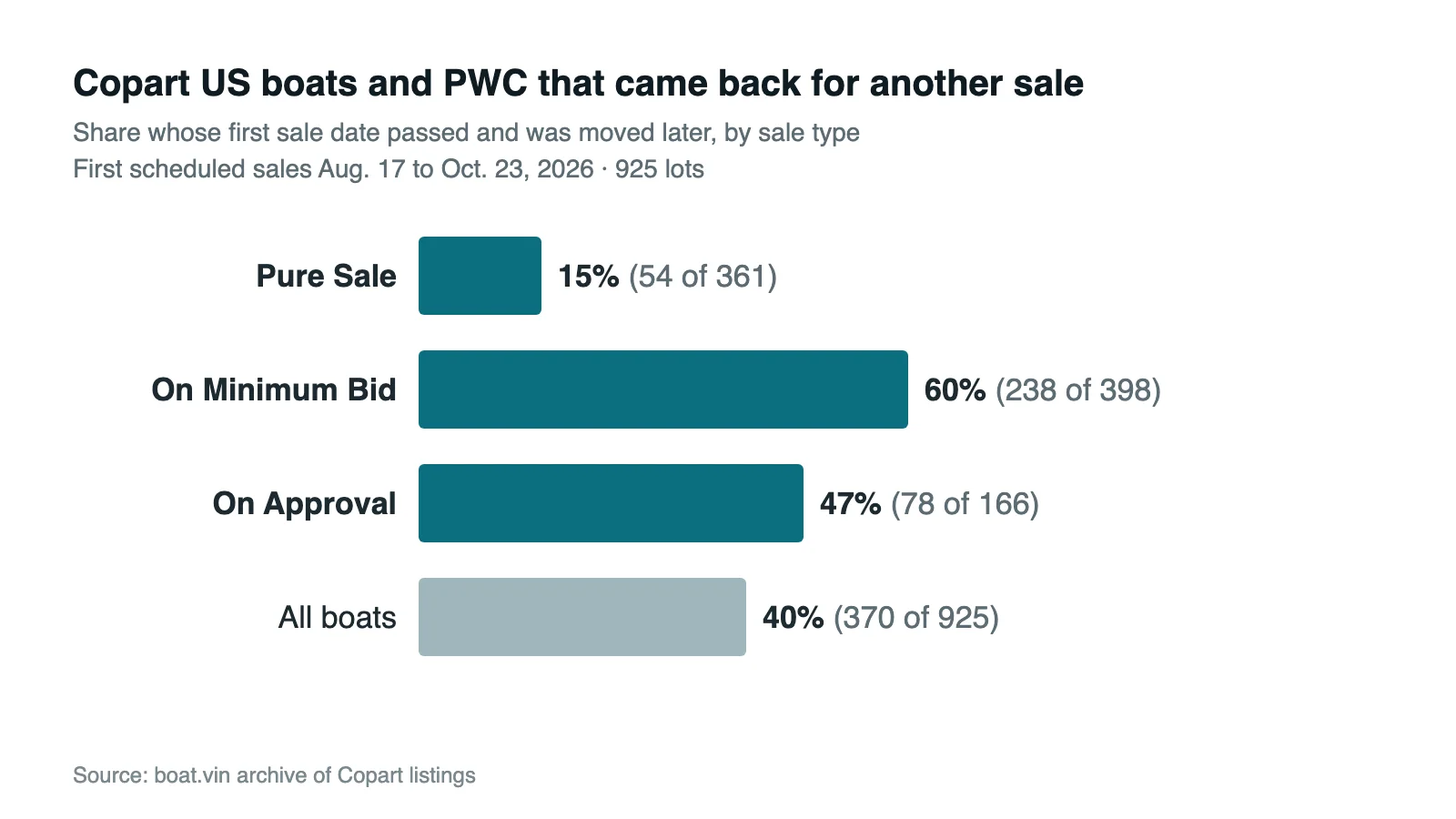
Six in ten Minimum Bid boats and nearly half of On Approval boats came back for another round. Only 15% of Pure Sale boats did. A Pure Sale can still slip, because a buyer may fail to pay or a lot may be pulled for paperwork, but it is far more likely to end with a boat changing hands.
Two cautions about these figures. First, the sale status we used is the lot's current one, and sellers sometimes change it between runs. Second, a relist doesn't tell us why the boat came back. A rejected bid is the most common reason on reserve lots, but not the only one. Read the figures as a pattern, not a prediction for any single lot.
The practical lesson is that a reserve lot is a negotiation. If you are bidding on one, decide in advance what you will say when the seller counters. Bid on several boats at once only if you could live with winning all of them, because sellers answer on their own schedule.
What the fees add up to
The hammer price is never the price. Both auctions add a buyer fee that rises with the sale price, a fee for bidding online, and a handful of fixed charges. The table below shows what they come to at six bid levels, using each auction's standard schedule for a licensed buyer as boat.vin's fee calculator applies it in November 2026: Copart's licensed member fees with a pre-bid, and IAA's licensed buyer fees with a proxy bid.
| Winning bid | Copart fees | IAA fees | Fees as a share of the bid |
|---|---|---|---|
| $500 | $383 | $400 | 77–80% |
| $1,000 | $568 | $590 | 57–59% |
| $2,500 | $833 | $850 | 33–34% |
| $5,000 | $1,058 | $1,025 | 21% |
| $10,000 | $1,203 | $1,280 | 12–13% |
| $25,000 | $2,243 | $2,155 | 9% |
At $2,500, Copart's $833 breaks down into a $630 buyer fee, a $79 gate fee, an $89 virtual bid fee, a $15 environmental fee and a $20 title handling fee. IAA's $850 is a $610 buyer fee, a $105 service fee for handling, imaging and loading, a $100 proxy bid fee, $15 environmental and $20 title handling.
The shape of the table matters more than any one line. Fees are heavily front-loaded: on a cheap boat they can almost double the price, and at $500 you hand over nearly as much in fees as for the boat itself. By $10,000 they have fallen to about an eighth. That is why a $700 jet ski is rarely the bargain it looks like, and why it pays to set a maximum bid from your total budget rather than from the number on the screen.
Three things will make your bill higher than the table. Fee schedules depend on the buyer: IAA publishes separate schedules for licensed buyers, non-licensed buyers, heavy vehicles and "Rec Rides" powersports units, and buying without a license or through a lot in a special category can cost more. Sales tax comes on top, at the rate of the state where the lot is sold, unless you can claim an exemption. And storage starts adding up once the free days after the sale run out. IAA says plainly that daily storage rates vary by branch and tells buyers to ask their local branch.
A worked example: the $2,500 bowrider
Back to the boat in Florida. Say you win it on Copart at $2,500 with a pre-bid:
| Line | Amount |
|---|---|
| Winning bid | $2,500.00 |
| Copart fees (buyer, gate, virtual bid, environmental, title) | $833.00 |
| Florida state sales tax, 6%, on bid and fees | $199.98 |
| Subtotal before transport | $3,532.98 |
| Broker fee, if you need one to bid (boat.vin rate, bid under $5,000) | $449.00 |
| With a broker | $3,981.98 |
Florida counties can add a local surtax on top of the 6% state rate. The table also leaves out storage if you are slow to collect, a trailer if the boat didn't come on one, and transport, which for a boat can cost much more than for a car of the same price because of the size and, for wider boats, oversize permits. In this example the boat you "bought for $2,500" costs close to $4,000 before it reaches your driveway, and before you have touched the engine.
What to check before you bid
Salvage auctions sell as-is, and the listing is all you get unless you can visit the yard. A few things on it deserve a hard look.
The title field
On boats, the title field is less reliable than on cars. Across 3,912 Copart US boat and PWC listings in boat.vin's archive, 2,763 were listed with a salvage title and 55 as parts only. Another 1,091 showed a title type of "None". That does not mean the boat has no title. It means no title information was given on the listing. Ask before you bid, because what you can do with the boat afterwards depends on what paper comes with it and on your state's rules for registering a rebuilt hull. Some states don't title boats at all, which is one reason boat paperwork is messier than car paperwork. Our guide to checking a used boat's history explains the state-by-state picture.
The damage field
Copart's primary damage label is a quick assessment made at the yard, not a survey. Among the same Copart US boats and PWC, the most common labels were water/flood (668 lots), minor dents (600), normal wear (457) and undercarriage (439). "Normal wear" on a boat that went through a hurricane is worth a second look at the photos. Water damage matters more on boats than its name suggests: a hull is built to sit in water, but engines, wiring, upholstery and fuel systems are not built to sit under it. Our earlier analysis found that half of the water-loss boats IAA sold in the US carried a clean title label, so a clean title tells you little about whether the boat has been flooded.
The HIN
Every boat built for the US market since 1972 carries a 12-character hull identification number. Run it through the boat.vin HIN decoder to confirm the builder and model year match the listing, and search the archive to see if the same hull has been through an auction before. A boat that keeps reappearing with a different story each time is telling you something. IAA masks part of the HIN on its listings, so you may only be able to check the builder code and serial until you win. For the rest of a boat's past, our free boat history check walks through the title, Coast Guard, recall and theft records.
The engine and the trailer
Salvage listings rarely say whether an engine runs, and an outboard can be missing entirely without the headline saying so. Look at every photo for the motor, the lower unit and the controls, and price the boat as if the engine needs work unless you can prove otherwise. Then check whether a trailer appears in the photos or the description. If it doesn't, assume you need one, or a transporter who can bring one.
After you win
The clock starts as soon as the auction ends. Payment deadlines are counted in business days, not weeks, and the auction charges late fees and then daily storage once the free period runs out. Arrange the money before you bid, and arrange the pickup before the boat is yours. For a boat in another state, line up a transporter who handles boats. Most car haulers aren't set up for one. Once it is home, the paperwork from the auction becomes the start of your state's titling or registration process, and a salvage-branded boat may need an inspection before it can go back on the water.
If you want to watch the market before committing, boat.vin's boat listings show the boats and personal watercraft we track on Copart and IAA in the US and Canada, with photos, damage, title and the fee estimate for each lot. You can also browse by make or by state.
About our numbers
The relist figures come from boat.vin's archive of Copart boat and personal watercraft listings in the US. They cover the 925 lots whose first scheduled sale fell between August 17, 2026, when we started recording sale-date changes, and October 23, 2026. A lot counts as relisted when its sale date passed and it then reappeared with a later date. The title and damage counts cover 3,912 Copart US boat and PWC listings in the archive as of November 6, 2026. Our archive doesn't capture final sale prices for boats, so we have not published any. Fee figures come from boat.vin's fee calculator, which applies the auctions' published schedules for licensed buyers. They are not quotes. Check the lot page and your account for the fees that apply to you.
Sources
- IAA, How to register as an IAA buyer (individual buyers, state eligibility, registration fee).
- IAA, Buyer fees, with the licensed, non-licensed and Rec Rides schedules.
- Copart, buyer's guide (sale status definitions, in Spanish).
- Florida Department of Revenue, sales and use tax.
- boat.vin archive of Copart and IAA boat and PWC listings, analysis dated November 2026.