
Buying guide
Repo boats for sale: where bank-repossessed boats actually go, and why so few end up at Copart
Only 11 of 1,525 Copart boat lots with a named seller came from a bank. Where lenders really sell repo boats, what the law says, and what to check before you bid.
By the boat.vin team · · 12 min read
In this guide
Search "repo boats for sale" with the name of your state and the results all look much the same. There are aggregator sites, bank auction directories, and a lot of Copart and IAA listings with photos of boats on trailers behind chain-link fences. That last part gives the impression that the salvage auctions are where repossessed boats end up. Mostly, they aren't.
We checked. boat.vin keeps an archive of every boat and personal watercraft that Copart and IAA list in the United States and Canada. Copart names the seller on part of its listings. Of the 1,525 US boat and jet ski lots in our archive where it does, 1,458 came from insurance companies. Eleven came from banks or credit unions.
That doesn't mean repo boats are hard to buy. It means they travel through other channels, under rules that differ from an insurance auction's, and the buyer gets something different too. Here is where they actually go, what the law says about how they have to be sold, and what you take on when you buy one.
What makes a boat a "repo"
A repossessed boat is collateral. Someone financed it, stopped paying, and the lender took it back under the security agreement they signed. In the United States the rules for what happens next are in Article 9 of the Uniform Commercial Code, which every state has adopted in some form (Florida's version, for example, is chapter 679 of its statutes).
The core rule is short. Under UCC § 9-610, after a default the lender may sell the collateral "in its present condition or following any commercially reasonable preparation". The sale can be public or private, but "every aspect" of it, including the method, manner, time, place and terms, must be commercially reasonable. Before selling, the lender generally has to notify the borrower and certain other parties (§ 9-611), and until the sale happens the borrower can still redeem the boat by paying off everything it secures plus the lender's reasonable costs (§ 9-623).
Two consequences matter to a buyer. First, a repo boat is usually sold as it was found, and the lender has no reason to fix it. Second, the lender isn't trying to give it away. Under § 9-615, the sale money goes first to the costs of repossessing and selling, then to the debt. The borrower may owe the difference if there is a shortfall, and a sale that wasn't commercially reasonable is exactly what a borrower's lawyer will attack when the lender tries to collect it. That's why many lenders use a channel they can defend, such as an established auction or a published sealed-bid sale, rather than selling to whoever calls first.
An insurance total works differently. Once an insurer pays a claim it owns the boat outright, and it sells it to recover part of what it paid. No borrower is waiting on the result. That difference shows up in the boats.
What 4,106 Copart listings say about who is selling
Our sample is every boat and personal watercraft that Copart listed for sale in the US with a sale date between August 17 and December 7, 2026: 4,106 lots, as recorded in boat.vin's archive on November 11, 2026. Copart showed a seller name on 1,525 of them (37%). Here is who those named sellers were.
| Named seller | Lots | Share of named lots |
|---|---|---|
| Insurers (Progressive 523, Farmers 349, GEICO 322, State Farm 262, Bristol West 2) | 1,458 | 95.6% |
| National Powersport Auctions | 48 | 3.1% |
| Banks and credit unions | 11 | 0.7% |
| Rental companies (Sixt 5, Fat Uncle Car Rental 1) | 6 | 0.4% |
| Other (one remarketing firm, one retailer) | 2 | 0.1% |
The other 2,581 lots, 63% of the total, carry no seller name, and that is where it gets interesting. Copart doesn't tell you who is behind them, but the damage labels on those boats look nothing like the insurers' boats.
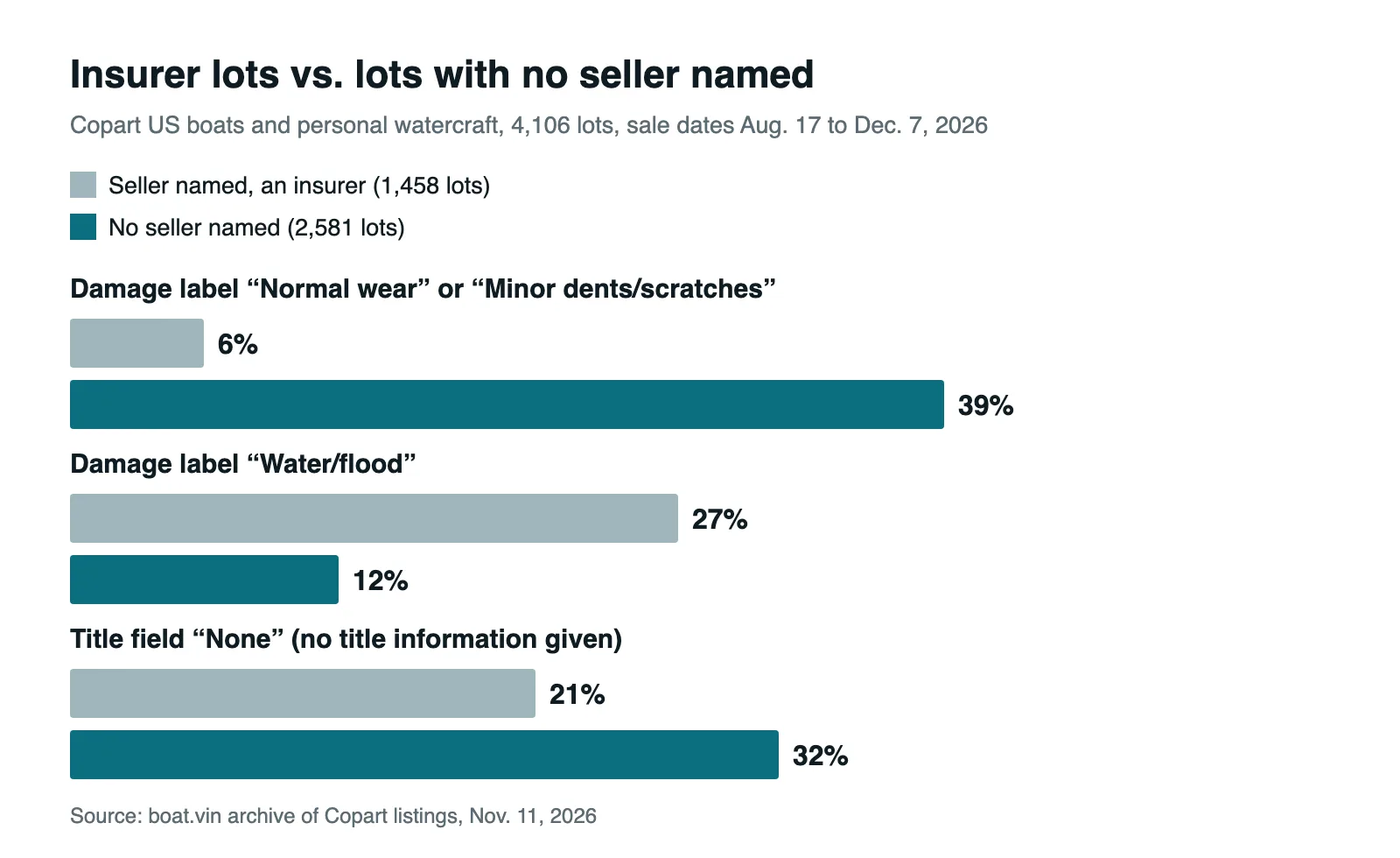
On insurer lots, only 6% carry the labels "Normal wear" or "Minor dents/scratches", the two labels Copart uses when there's no real accident damage to report. On lots with no seller named, that figure is 39%: 1,008 boats. Flood is the reverse. 27% of insurer lots are labeled "Water/flood", against 12% of the unnamed ones. And 32% of unnamed lots give no title information at all (the title field reads "None"), against 21% for insurers.
A boat that is only worn didn't get there through an insurance claim. Those 1,008 boats were consigned by someone who wanted to sell an intact boat: dealers clearing trade-ins, charities selling donated boats, fleets, and some lenders. We can't tell which is which from the listing, and we won't pretend we can. What the numbers do support is narrower and still useful. If you're looking for a boat that was taken back, not wrecked, the unnamed "Normal wear" lots are where to look on Copart. A Copart listing alone won't prove a boat is a repo.
The eleven lots a lender put its name on
These are the Copart US lots in our sample where the named seller is a bank or credit union. They're few, but they show what a lender's boat looks like at a salvage auction.
| Seller | Boat as listed | Yard | Copart damage label |
|---|---|---|---|
| Pelican State Credit Union | 2022 Bennington with trailer | Shreveport, LA | Minor dents/scratches |
| Pelican State Credit Union | 2016 Skeeter | Greenwell Springs, LA | Undercarriage |
| Pelican State Credit Union | 2013 Skeeter | New Orleans, LA | Normal wear |
| North Star Community Credit Union | 2021 Tracker Classic XL | McFarland, WI | Normal wear |
| North Star Community Credit Union | 1995 Manitowoc | Bismarck, ND | Minor dents/scratches |
| Cosden Federal Credit Union | 2019 Tracker | Reno, NV | Minor dents/scratches |
| Southland Federal Credit Union | 2010 Tahoe | Lufkin, TX | Mechanical |
| Minnequa Works Credit Union | 2006 boat | Brighton, CO | Minor dents/scratches |
| Gate City Bank | 2006 Tracker | Bismarck, ND | Normal wear |
| First United Bank | 2001 Baja | Oklahoma City, OK | Normal wear |
| First United Bank | 1994 Mariah | Tulsa, OK | Undercarriage |
Eight of the eleven are labeled "Normal wear" or "Minor dents/scratches", and none is labeled as a flood boat. They're mostly bass boats, pontoons and family runabouts, the kind of boat people finance and then stop paying for. Most sit in inland yards, a long way from the storm-damaged boats that fill so many insurer lots. In Canada the picture is similar: Copart named a seller on just 14 of the 229 Canadian boat and jet ski lots in our archive, and none of the 14 was an insurer.
IAA, the other big salvage auction, doesn't show the seller at all (its listings say "Please log in as a buyer" where the name would be). What IAA does record is the type of loss. Of the 1,264 US boats and personal watercraft in our archive, 548 are listed as collision, 257 as water, 49 as fire, 23 as theft and 276 as "Other". "Other" is the bucket where a boat that wasn't wrecked would land. It isn't proof of a repo either.
Where lenders actually sell repossessed boats
If not mainly at Copart and IAA, then where? A lender has four realistic options, and each one reaches the public differently.
The lender's own sale page
Many banks and credit unions sell repossessed collateral themselves, through a page on their website that lists the vehicles, boats and sometimes homes they have taken back. Bidding is often by sealed bid within a deadline. Seaboard Federal Credit Union's "Private Sale by Bid" page is a typical example. It says the credit union "may auction off reclaimed property" from time to time and that bids are placed on the page. When we checked, it had nothing listed. That's the catch with this channel: listings are sporadic, local, and gone in a week or two.
For a buyer this is the closest thing to a true "bank repo" deal. You deal with the lender directly, there's no auction buyer's fee, and the lender usually has the title. The sale is almost always as-is, and you may only get a short viewing window. If you're hunting in a particular state, the practical method is unglamorous: list the credit unions and community banks near the water in your area and check their repo pages every week or two.
Dealer-only wholesale auctions
Some repossessed boats go to wholesale auctions that only licensed dealers can attend. They reach the public later, on a dealer's lot, with a dealer's markup and sometimes some reconditioning. National Powersport Auctions shows up in our Copart data as the named seller on 48 boats. 46 of the 48 carry the damage label "All over", meaning damage across the whole boat. We couldn't load its own site to confirm how its sales work, so we'll leave it at that.
Salvage auctions: Copart and IAA
Some lenders do consign boats to Copart or IAA, as the eleven lots above show. For a lender, that buys a large audience of buyers, a documented sale and someone else handling storage and payment. For you it means the auction's rules apply: registration, buyer's fees, and in some states a dealer license or a broker to bid on boats. Our guide on how to buy a boat at Copart or IAA covers who can bid and what the fees add up to. The fees alone can add several hundred dollars to a $2,500 boat.
Marina and storage lien sales
Strictly speaking these aren't repos, but they come up in the same searches and are often the best deals. When an owner stops paying the marina or the storage yard, state law usually lets the yard sell the boat to recover what it's owed. Florida's rules, in section 328.17 of the Florida Statutes, show how this works. The marina has a possessory lien for storage, dockage and repairs. It must give the owner and any lienholders written notice at least 60 days before a sale. It must then advertise the sale in a local newspaper once a week for two consecutive weeks, and the sale cannot happen sooner than 15 days after the first advertisement. The sale also has to be "commercially reasonable", the same standard as the UCC.
In practice that means the boats are announced in the legal-notice section of local papers and on the marina's own notice board, not on a national website. Other states have their own versions with different deadlines, so read your state's statute before relying on a lien sale.
What you actually get when you buy a repo
This is where repo buyers get caught out, and where a lender sale differs most from buying from a private seller.
You get the borrower's rights, not a fresh start. Under UCC § 9-617, the lender's sale transfers "all of the debtor's rights" in the boat to the buyer, discharges the lender's own security interest, and discharges any junior liens. It does not wipe out liens that rank ahead of the lender's. A marina's storage lien is the usual example: a boat that sat unpaid in a yard before the lender seized it may come with a lien the bank's sale doesn't clear. Florida's marina statute makes the same point from the other side. A good-faith buyer at a marina lien sale takes the boat free of other claims "other than a prior lien perfected under state or federal law".
The warranty of title can be disclaimed. By default, a sale under § 9-610 carries the same warranties of title and quiet possession as any ordinary sale. But the lender can disclaim them in writing, and the code even gives the wording: "There is no warranty relating to title, possession, quiet enjoyment, or the like in this disposition." If you see that sentence or something like it in the bid terms, the lender is telling you it won't stand behind the paperwork. Then you have to check it yourself.
"As-is" means as-is. A lender didn't use the boat, often never ran it, and may not have the keys or the manuals. Ask how long the boat sat and where. A boat that spent a winter on a trailer in a repo lot without being winterized can have a cracked block that no photo will show.
Checks to make before you bid on a repo boat
None of this needs a lawyer for an ordinary boat. Most of it takes an afternoon.
- Get the hull identification number (HIN) and decode it. It tells you the builder and model year and whether the format is valid. Our HIN decoder does that for free, and our guide to checking a boat's history explains what to do with the result. Compare it with the HIN on the title or registration, character by character.
- Find out what paperwork the lender has. Ask whether there is a title (in titling states), a registration, a release of the lender's lien, and a separate title for the trailer if your state titles trailers. In states that don't title boats, the bill of sale and the registration history carry more weight.
- Search for other liens. Check the state titling or registration agency's record for lienholders. For a federally documented vessel, ask the Coast Guard's National Vessel Documentation Center for an abstract of title. For a boat that sat at a marina, ask the marina directly whether anything is owed.
- Check whether it has been to auction before. Search the HIN on boat.vin. A repo boat that already went through Copart or IAA as an insurance loss tells a different story than one that has never been seen at a salvage sale.
- Look at it or have it surveyed. For anything worth more than a few thousand dollars, a marine surveyor's inspection usually costs much less than one surprise repair. At the very least, check the transom and the floor for soft spots, check the engine oil for water, and turn the motor over by hand.
- Price it against real sales, and add the costs. A repo isn't automatically cheap. Add the buyer's fees (if it's at an auction), sales tax, transport, registration and the cost to recommission a boat that has sat. Our guide on buying at Copart or IAA has a worked example of the full cost.
Michigan, North Carolina, California and Florida
Most searches for repo boats name a state, so here is what our archive shows for three that come up in our own search data, plus Florida, the biggest boat market at Copart. These are Copart US boat and personal watercraft lots with a sale date between August 17 and December 7, 2026, and how many of them had no seller named.
| State | Copart lots | No seller named |
|---|---|---|
| Florida | 543 | 387 (71%) |
| California | 219 | 170 (78%) |
| Michigan | 174 | 130 (75%) |
| North Carolina | 116 | 71 (61%) |
Each state page lists the boats currently for sale there at Copart and IAA, with photos, the auction's damage and title labels, and an all-in cost estimate on each lot page. None of them is labeled "repo", because neither auction uses that label. If you want a repossessed boat specifically, the salvage auctions are one channel among four, and probably not the best one. Pair them with the local lenders' sale pages and the legal notices from marinas. That's a more realistic way to find one than any "repo boats near me" site.
Sources and method
Auction figures come from boat.vin's archive of Copart and IAA listings as it stood on November 11, 2026. The Copart US sample is every boat and personal watercraft lot with a sale date from August 17 to December 7, 2026 (4,106 lots). Seller names, damage labels and title fields are as the auction published them. Copart's damage labels are quick yard descriptions, not inspections. Grouping a lot as "no seller named" only means Copart didn't display one.
- Uniform Commercial Code, Article 9, §§ 9-610, 9-611, 9-615, 9-617 and 9-623, Legal Information Institute, Cornell Law School. States enact the code with their own variations.
- Florida Statutes § 328.17, Nonjudicial sale of vessels (2026 Florida Statutes).
- Seaboard Federal Credit Union, "Private Sale by Bid", consulted November 11, 2026.
- boat.vin archive of Copart and IAA boat and personal watercraft listings, November 11, 2026.